‹
›
›
‹
×
![]()
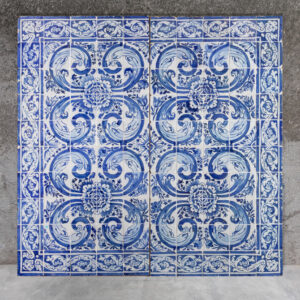
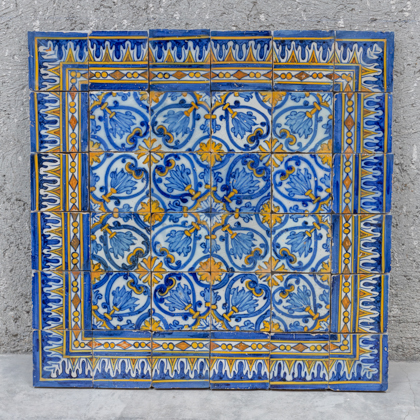
“Carpet” Pattern Tile Panel – 17th Century
Period: 17th century
Dimensions: 84 x 84 cm
Description:
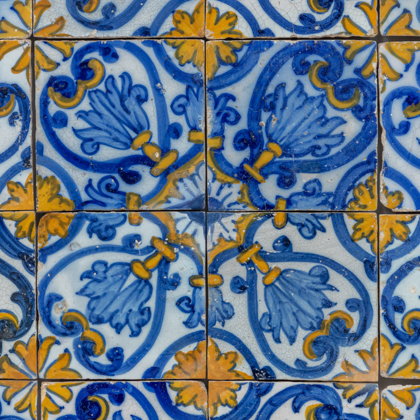
A 17th-century Portuguese tile panel, crafted using the majolica technique, with polychrome decoration in cobalt blue and yellow on a white background. The composition features a pattern of stylized plant motifs, including acanthus leaves, scrollwork, and floral elements, arranged according to a geometric structure of repetition and symmetry. The central field is bordered by a frame consisting of several ornamental bands, which combine geometric and plant motifs, creating a separation between the pattern and the surrounding architectural space.
During the 17th century, the so-called “carpet” patterns took on particular importance in Portuguese tilework, being used to cover large interior surfaces, especially in churches, convents, and noble residences. Inspired by the ornamental patterns of woven tapestries, these tile coverings consisted of repeating tile modules, forming continuous compositions framed by borders. The combination of floral and geometric motifs reflects the influence of European decorative traditions and the consolidation of a distinctive style in 17th-century Portuguese tile art. In this panel, the interplay between the central pattern and the different bands of the border illustrates how the tile was conceived as an integral part of the architecture, transforming the wall surface into a continuous ornamental covering.
Are you interested in this product?